AIPE Newsletter | 1st – 15th February 2026
The first half of February 2026 marks a consequential phase in India’s insolvency and restructuring landscape, characterised by anticipated legislative reforms, evolving judicial reasoning, and heightened regulatory discipline. This edition of the AIPE Newsletter captures the emerging policy direction and its practical implications for creditors, insolvency professionals, and market participants.
Executive Overview – Mechanical Admissions & Creditor-Driven Processes
Recent developments signal a broader structural shift within the insolvency framework. The proposed reforms under the Insolvency and Bankruptcy Code (Amendment) Bill, 2025 emphasise greater predictability in admissions, clearer treatment of security interests, and the increasing prominence of creditor-initiated resolution models. Judicial forums continue to reinforce core IBC principles, particularly procedural discipline, commercial wisdom, and value preservation.
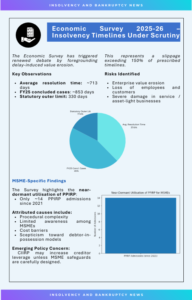
Parallel policy discussions, influenced by observations in the Economic Survey 2025-26, highlight systemic concerns surrounding resolution timelines and MSME-specific challenges. These developments collectively underscore the need for procedural efficiency, institutional accountability, and strategic agility within the ecosystem.
From the CEO’s Desk – Recalibrating Recovery Strategies
This issue features an analytical perspective on India’s evolving insolvency architecture and its impact on creditor behaviour. With legislative refinements targeting promoter accountability, guarantor liability, and related-party scrutiny, creditors are increasingly reassessing enforcement strategies and risk evaluation frameworks. The emerging jurisprudence reflects a system progressively aligned with economic realities and creditor protection objectives.
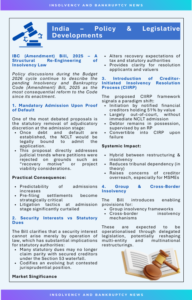
Policy & Legislative Developments
Key themes examined include:
- Mandatory admission upon proof of default and its implications for adjudicatory discretion
- Clarification of security interests vis-à-vis statutory dues
- Expansion of creditor-initiated insolvency resolution mechanisms
- Frameworks enabling group and cross-border insolvency proceedings
These measures aim to enhance certainty, reduce procedural disputes, and strengthen resolution efficiency.
Resolution Timelines Under Scrutiny
Insights drawn from the Economic Survey reveal persistent concerns regarding prolonged resolution periods, delayed recoveries, and enterprise value erosion. MSME-specific observations further highlight structural limitations and adoption challenges under pre-packaged insolvency frameworks, reinforcing the urgency of calibrated policy responses.
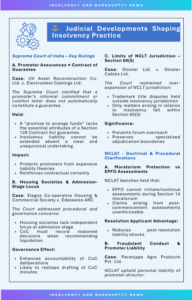
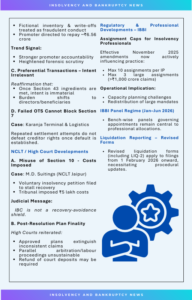
Judicial Developments Shaping Practice
Significant judicial trends include:
- Clarifications on promoter assurances and guarantor liabilities
- Reinforcement of CoC reasoning and documentation standards
- Jurisdictional boundaries under Section 60(5) of the IBC
- Treatment of moratorium protections in regulatory enforcement contexts
Collectively, these rulings continue to refine procedural certainty and creditor safeguards.
Regulatory & Professional Developments – IBBI
The newsletter also highlights evolving regulatory measures affecting insolvency professionals and Insolvency Professional Entities (IPEs), including:
- Assignment caps and capacity considerations
- Revisions to liquidation reporting formats
- Continued emphasis on disclosure integrity and compliance discipline
These developments reflect the regulator’s sustained focus on institutional governance and procedural standardisation.
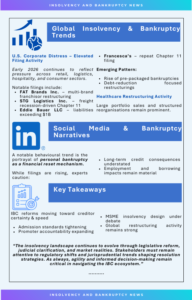
Global Insolvency & Bankruptcy Trends
International restructuring activity remains elevated across sectors, particularly retail, logistics, and healthcare. Global patterns continue to emphasise pre-packaged mechanisms, debtor-in-possession models, and cross-border coordination frameworks, offering comparative insights for India’s evolving regime.
The insolvency landscape continues to evolve through legislative refinement, judicial interpretation, and market realities. For stakeholders across the ecosystem, preparedness, procedural discipline, and informed decision-making remain critical.
For AIPE publications and professional updates:
🌐 Website: www.aipe.org.in
📱 Follow AIPE: @AIPEI_N