By Mr. Sanjeev Pandey
Ceo, AIPE
Introduction
The Corporate Insolvency Resolution Process (CIRP) under India’s Insolvency and Bankruptcy Code (IBC) was designed to provide a time-bound mechanism for resolving corporate distress. However, the reality has been markedly different, with cases frequently exceeding the statutory 330-day timeline due to extensive litigation and inter-creditor disputes. Drawing insights from global best practices in insolvency mediation, there is a compelling case for integrating mediation mechanisms within the CIRP framework, particularly through the Committee of Creditors (CoC), to address these challenges systematically.
The international experience demonstrates that mediation in insolvency matters has evolved from an experimental approach to a recognized best practice. As noted in comparative studies, mediation serves multiple purposes in insolvency frameworks: resolving two-party disputes efficiently, facilitating multiparty negotiations, and operating both in pre-insolvency situations and after formal proceedings have commenced. The success of mediation in complex cases like Lehman Brothers, where numerous investor claims were resolved through alternative dispute mechanisms, illustrates the potential for significant cost savings and expedited resolution.
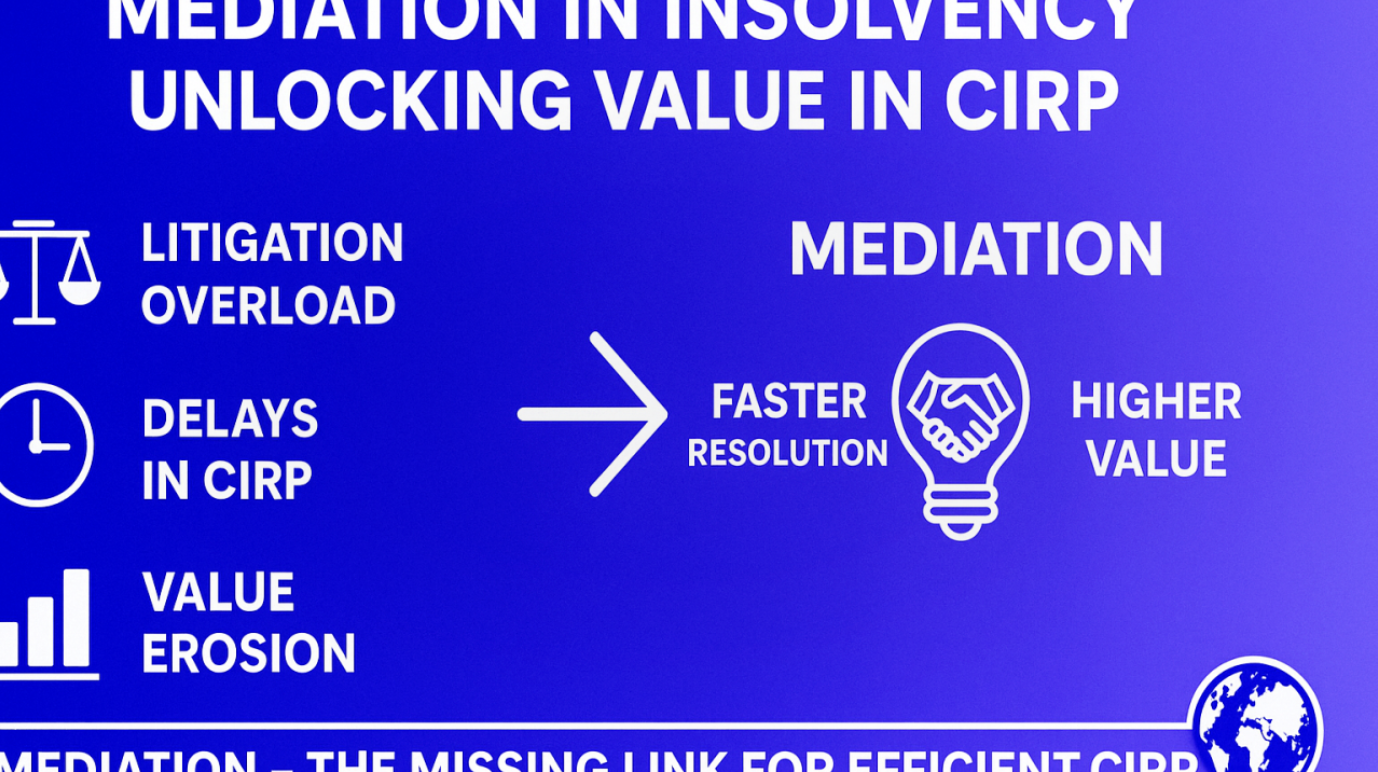
The Current Challenge: Litigation Overload in CIRP
The Indian CIRP process faces several structural challenges that mediation can address. Inter-creditor disputes frequently arise over asset valuation, priority of claims, distribution mechanisms, and approval of resolution plans. These disputes often result in multiple rounds of litigation before the National Company Law Tribunal (NCLT) and appellate forums, creating a cascade effect that extends timelines and erodes asset values.
Current statistics reveal that the average resolution time under CIRP significantly exceeds almost double the intended timeline, with litigation being a primary contributor to delays. The adversarial nature of traditional dispute resolution mechanisms exacerbates tensions among stakeholders, often leading to outcomes that are suboptimal for all parties involved. Moreover, the costs associated with protracted litigation reduce the pool of assets available for distribution to creditors, undermining the fundamental objective of value maximization.
The CoC, comprising financial creditors holding the majority of the debt, possesses the authority to make crucial decisions regarding the resolution process. However, disagreements within the CoC or between the CoC and other stakeholders often result in deadlocks that can only be resolved through judicial intervention, further complicating an already complex process.
Mediation: A Proven Alternative for Insolvency Disputes
International experience provides compelling evidence for the effectiveness of mediation in insolvency contexts. The European Union’s approach, as reflected in the 2014 Commission Recommendation on Business Failure and Insolvency and the proposed Restructuring Directive, specifically recognizes mediation as a valuable mechanism for business rescue endeavours. The flexibility inherent in mediation processes makes them particularly suitable for the complex, multiparty negotiations that characterize insolvency proceedings.
Mediation offers several distinct advantages in the insolvency context. First, it provides confidentiality, which is crucial during the twilight period of pre-insolvency situations where disclosure of financial distress could accelerate business failure. Second, mediation allows for creative, customized solutions that rigid legal frameworks might not accommodate. Third, it preserves relationships among stakeholders, which can be valuable for ongoing business operations or future commercial dealings.
The success of mediation in insolvency matters depends significantly on the expertise of mediators. Unlike general commercial mediation, insolvency mediation requires specialized knowledge of financial restructuring, corporate law, and business valuation. Since many Insolvency Professionals in India come from CA or Banking background, they can be effective mediators. Many jurisdictions have established specialized panels of mediators with appropriate qualifications in insolvency and financial matters to ensure effective outcomes.
Strategic Implementation Within the CoC Framework
The CoC represents an ideal forum for implementing mediation mechanisms within the CIRP process. Under the Code, CoC has been provided with enormous powers to take commercial decisions and run the Corporate Insolvency process to a positive outcome. Basically, the Code has provided a design for CoC which can take most of the relevant decisions to maintain continuity of CD, to preserve its value and to accommodate the interests of a varied set of creditors. Given its composition of sophisticated financial creditors and its decision-making authority, the CoC can establish internal mediation protocols to address disputes efficiently before they escalate to formal litigation.
Internal Dispute Resolution Mechanisms
The CoC can adopt internal mediation procedures for resolving disputes among financial creditors regarding resolution plan evaluation, asset valuation disagreements, and distribution priorities. These procedures should be built into the CoC’s standard operating framework, with clear triggers for when mediation should be initiated. For instance, when a significant minority of creditors disagrees with a majority decision, or when technical disputes arise regarding asset valuation or business viability assessments, automatic referral to mediation could prevent costly litigation.
The CoC can maintain a panel of pre-approved mediators with expertise in insolvency matters, financial restructuring, and industry-specific knowledge. This approach ensures that mediators understand the commercial realities and technical complexities involved in corporate insolvency, leading to more informed and practical solutions.
Stakeholder Engagement Through Mediation
Beyond internal disputes, the CoC can utilize mediation to engage with other stakeholders, including operational creditors, employees, and resolution applicants. Rather than allowing disputes to escalate to the NCLT, mediated discussions can address concerns about employment protection, operational creditor treatment, or modifications to resolution plans. This approach not only reduces litigation but also builds consensus around resolution strategies, increasing the likelihood of successful implementation.
The CoC can also establish structured mediation processes for engaging with resolution applicants when disputes arise regarding plan terms, implementation timelines, or post-resolution commitments. Such mediation can result in plan modifications that address legitimate concerns while maintaining commercial viability, avoiding the need for plan rejection and re-initiation of the resolution process.
Value Preservation and Cost Optimization
The integration of mediation within the CIRP process through the CoC offers significant potential for value preservation and cost optimization. Litigation costs in insolvency cases are substantial, encompassing legal fees, expert witness costs, court fees, and the opportunity costs associated with delayed resolution. These costs are ultimately borne by the corporate debtor’s estate, reducing the funds available for creditor distribution.
Accelerated Resolution Timelines
Mediation can significantly accelerate dispute resolution compared to traditional litigation. While court proceedings may take months or years to resolve, well-structured mediation processes can often achieve resolution within weeks. This acceleration is particularly valuable in insolvency contexts where asset values may be deteriorating due to business disruption or market conditions.
The time saved through mediation allows for faster implementation of resolution plans, reducing the period of uncertainty for employees, suppliers, and customers. This stability preservation can maintain business relationships and operational capabilities that might otherwise be lost during protracted proceedings, ultimately enhancing the value realized through the resolution process.
Enhanced Recovery Rates
By reducing the costs associated with dispute resolution and accelerating the overall process, mediation can enhance recovery rates for creditors. International studies suggest that insolvency cases resolved with minimal litigation often achieve higher recovery rates than those involving extensive court proceedings. The preservation of business value through expedited resolution, combined with reduced administrative costs, creates a larger pool of assets for distribution among stakeholders.
Furthermore, the collaborative nature of mediation can identify creative value-enhancement opportunities that adversarial litigation might not uncover. For instance, mediated discussions might reveal synergies between resolution applicants and existing operations or identify asset monetization strategies that maximize realization values.
Implementation Framework and Best Practices
To effectively integrate mediation within the CIRP process through the CoC, several implementation considerations must be addressed. The framework should include clear procedural guidelines, qualification requirements for mediators, confidentiality protections, and enforcement mechanisms for mediated agreements. To begin with, I think it may be a good idea to identify Mediators also as service providers under IBC amendment bill 2025.
Procedural Integration
The proposed code of conduct for CoC, as proposed under the amendment bill, should establish mediation as a default mechanism for certain categories of disputes, with clear criteria for when mediation is mandatory versus voluntary. Time constraints should be built into the mediation process to prevent delays, drawing from successful international models like Singapore’s structured mediation timelines. The integration should also provide for escalation mechanisms when mediation fails to achieve resolution.
The process should include provisions for specialized mediators based on the nature of disputes. Technical disputes regarding asset valuation might require mediators with financial and asset specific valuation expertise, while operational disputes might benefit from mediators with industry-specific knowledge. The CoC can maintain relationships with mediation institutions to ensure access to appropriately qualified mediators.
Conclusion
The integration of mediation mechanisms within the CIRP process through the Committee of Creditors represents a pragmatic approach to addressing the current challenges of excessive litigation and delayed resolution. International experience demonstrates that mediation can significantly reduce costs, accelerate resolution timelines, and preserve asset values in insolvency contexts. Even Adjudicating Authorities may also refer some of the disputes related to insolvency proceedings for time bound mediation rather than giving multiple hearings for lack of time or understanding of the underlying matter of dispute.
The CoC’s unique position as the primary decision-making body in CIRP proceedings makes it an ideal forum for implementing these mediation mechanisms. By establishing internal dispute resolution procedures, engaging stakeholders through mediated processes, and maintaining panels of qualified mediators, the CoC can address most inter-creditor and stakeholder disputes without resort to formal litigation.
The benefits of this approach extend beyond immediate cost and time savings. Mediation can preserve business relationships, maintain operational stability, and create opportunities for value enhancement that purely adversarial processes might not achieve. As India continues to refine its insolvency framework, the strategic integration of mediation represents an important evolution toward more efficient and effective corporate insolvency resolution.
The success of this approach will depend on the willingness of stakeholders to embrace collaborative dispute resolution and the development of appropriate institutional support for mediation in insolvency contexts. However, the potential rewards—reduced costs, accelerated timelines, enhanced recovery rates, and preserved business value—make this an initiative worthy of serious consideration and implementation.