

The Insolvency and Bankruptcy Board of India (IBBI) has released a significant discussion paper focused on enhancing the integrity of the Corporate Insolvency Resolution Process (CIRP). The paper puts forth important regulatory proposals such as: => Formalizing the Committee of Creditors’ (CoC) deliberations and responsibilities around Section 29A eligibility, thereby strengthening collective due diligence and […]

The Insolvency and Bankruptcy Code (Amendment) Bill, 2025, proposes the most comprehensive overhaul since the IBC’s inception. Key changes include: ✅ Creditor-Initiated Out-of-Court Insolvency (CIIRP) – faster, NCLT-free resolution for qualifying debtors. ✅ Group & Cross-Border Insolvency – aligning India with global best practices, enabling coordinated resolutions and UNCITRAL-style recognition. ✅ Tighter Timelines & Limited […]
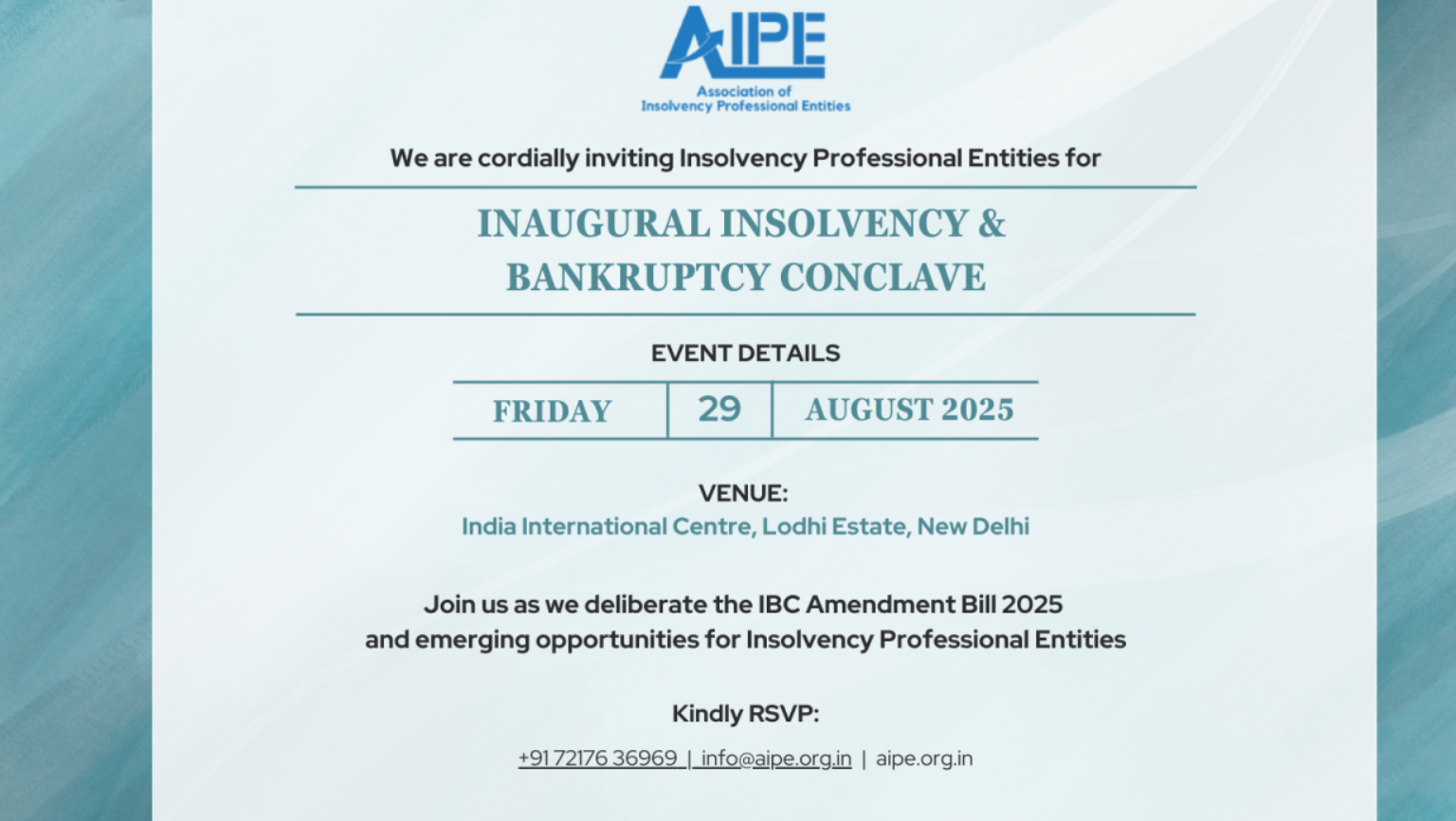
Join us for an insightful discussion with industry leaders, insolvency professionals, and legal experts as we delve into the evolving landscape of insolvency practice and corporate governance. ✅ Registration is now open through Google Form – secure your spot today! 🔗https://lnkd.in/g2hJaz_h Don’t miss this opportunity to connect, learn, and exchange perspectives with peers and thought leaders. Event […]

🇮🇳 Celebrating the Spirit of Independence 🇮🇳 This Independence Day, we at AIPE honor not just the freedom hard-won by our nation, but also the responsibility that comes with it. Freedom is not merely the absence of constraints; it is the power to act with integrity, to innovate fearlessly, and to contribute meaningfully to the growth of our society […]
By Mr. Sanjeev Pandey, CEO, AIPE Introduction Imagine you’re building a big project, like a new highway, a power plant, or a housing complex. These projects need a lot of money, often borrowed from banks or financial institutions. To make sure this lending is done responsibly, the Reserve Bank of India (RBI) has introduced new […]
The court’s decision highlights that persistent inclusion of debt in audited balance sheets from FY 2015-16 to FY 2022-23 serves as a valid acknowledgment under Section 18, resetting the limitation clock as established in previous Supreme Court rulings. Key principles from the Supreme Court’s Bishal Jaiswal case underscore that a clear and conscious admission of […]

Article written by Sanjeev Pandey Introduction The National Company Law Appellate Tribunal (NCLAT) has delivered a significant judgment in the case of Girish Siriram Juneja v. Soneko Marketing Pvt. Ltd. and Ors. (decided on July 8, 2025), which has far-reaching implications for insolvency professionals operating under the Insolvency and Bankruptcy Code, 2016 (IBC). The ruling […]
BREAKING | ‘Art 142 Used To Do Injustice’: Supreme Court Recalls Judgment Which Rejected JSW’s Resolution Plan For Bhushan Power & Steel Hon’ble Apex Court held as under: * Prima facie, we are of the view that the impugned judgment does not correctly lay down the legal position. * It is contrary to the law […]
Meet AIPE—Association of Insolvency Professional Entities We’re building a stronger insolvency ecosystem through collaboration, capacity-building, and community. https://lnkd.in/gdm2AdbK ⚖️ Events • Insights • Policy • Practice 👉 Follow @aipei_nd and stay updated. 📢 Share with fellow IPs & professionals! hashtag#AIPE hashtag#IBCIndia hashtag#InsolvencyProfessionals hashtag#CorporateLaw hashtag#RestructuringIndia

The Supreme Court’s recent ruling in IL&FS Financial Services Ltd. v. Adhunik Meghalaya Steels Pvt. Ltd. sets a significant precedent in Indian insolvency and limitation law under the IBC. 🔎 Key Insights: The Court held that entries in a company’s balance sheet—even without a creditor’s specific name—can serve as a valid acknowledgment of debt under […]