AIPE Newsletter | 15th – 31st January 2026
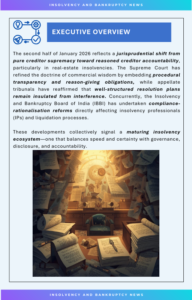
The second half of January 2026 reflects important jurisprudential and regulatory developments that continue to shape India’s insolvency and restructuring landscape. This edition of the AIPE Newsletter captures the evolving judicial approach, policy signals, and professional practice implications emerging from recent decisions and regulatory measures.
Executive Overview – A Shift Toward Creditor Accountability
Recent judicial pronouncements indicate a gradual but significant shift from pure creditor supremacy toward a framework emphasising reasoned creditor accountability. Courts have reinforced procedural transparency, recording of rationale, and disciplined exercise of commercial wisdom, while simultaneously safeguarding well-structured resolution plans from unwarranted interference. Collectively, these developments signal the maturation of India’s insolvency ecosystem, balancing speed with governance, disclosure, and certainty.
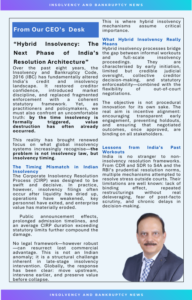
From the CEO’s Desk – Hybrid Insolvency & Early Intervention
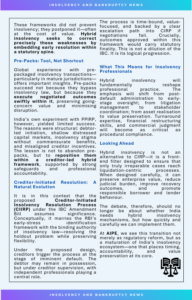
This issue features an analytical discussion on hybrid insolvency mechanisms and creditor-initiated resolution models. The article examines structural challenges in late-stage insolvencies, the limitations of traditional frameworks, and the growing relevance of early intervention tools that preserve enterprise value. The perspective underscores a broader global movement toward flexible yet creditor-driven restructuring architectures.
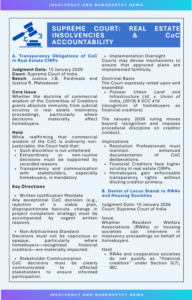
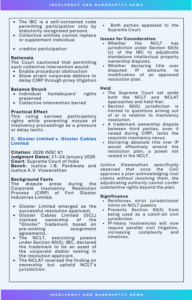
Supreme Court – Real Estate Insolvencies & CoC Accountability
Key rulings during the period have emphasised:
- Enhanced transparency obligations in real estate CIRPs
- Written justification requirements for CoC decisions
- Reinforcement of stakeholder communication duties
- Judicial restraint in interfering with commercial decisions absent exceptional circumstances
The decisions collectively strengthen governance standards without diluting creditor primacy under the Code.
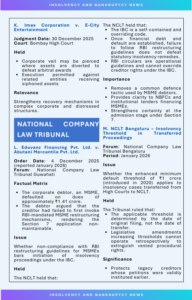
Jurisdictional Clarity Under Section 60(5)
Significant judicial observations have clarified the limits of NCLT jurisdiction, particularly in matters involving independent civil disputes such as ownership and trademark claims. The rulings reaffirm that the insolvency forum cannot serve as a substitute for parallel civil adjudication, thereby preserving doctrinal coherence and procedural certainty.
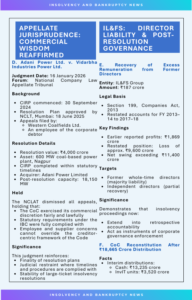
Appellate Jurisprudence & Commercial Wisdom
Appellate decisions continue to reinforce the principle that CoC decisions, when taken within the statutory framework and supported by procedural compliance, warrant judicial deference. These rulings contribute to stability in large-value resolutions and minimise disruptive litigation risks.
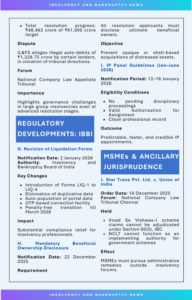
Regulatory Developments – Compliance & Disclosure Focus
The newsletter highlights notable regulatory trends, including revisions to liquidation forms, strengthened beneficial ownership disclosure requirements, and broader compliance rationalisation efforts aimed at improving procedural efficiency and transparency.
MSMEs & Ancillary Jurisprudence
Emerging decisions affecting MSMEs and restructuring frameworks reiterate the boundaries between regulatory compliance regimes and insolvency initiation thresholds, with important implications for creditor strategy and debtor conduct.
India’s insolvency regime continues to evolve toward a more disciplined, transparency-driven resolution framework where governance, accountability, and procedural integrity play an increasingly central role.
For AIPE publications, updates, and resources:
🌐 Website: www.aipe.org.in
📱 Follow AIPE: @AIPEI_N