

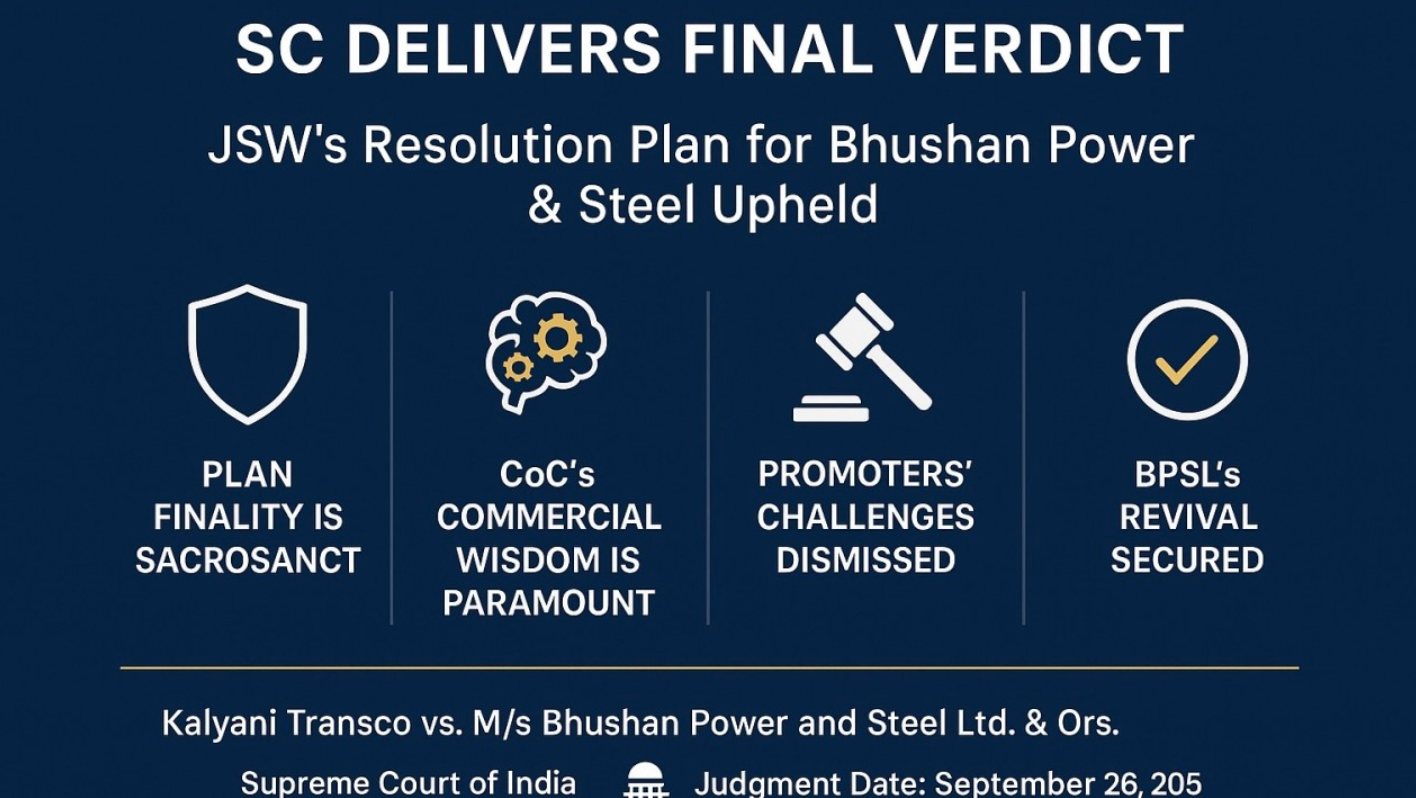
The landmark judgment by the Supreme Court of India, delivered on September 26, 2025, provides finality to the long-drawn-out Corporate Insolvency Resolution Process (CIRP) of M/s Bhushan Power and Steel Limited (BPSL). The Court dismissed all appeals filed by the erstwhile promoters and various operational creditors, thereby upholding the resolution plan submitted by JSW Steel Limited, which was earlier approved by the National Company Law Appellate Tribunal (NCLAT).
The judgment robustly reaffirms several core principles of the Insolvency and Bankruptcy Code (IBC), 2016:
Finality of the Resolution Plan: The Court decisively rejected the claim for the distribution of EBITDA (Earnings Before Interest, Taxes, Depreciation, and Amortization) generated during the CIRP. Citing its own precedent in the Essar Steel case, it held that a successful resolution applicant cannot be faced with new, undecided claims after a plan is approved. This prevents “hydra heads popping up” and ensures the applicant takes over the company on a ‘clean slate’.
Supremacy of CoC’s Commercial Wisdom: The Court refused to interfere with the Committee of Creditors’ (CoC) decisions, including the approval of JSW’s plan, the classification of certain creditors, and the extension of the implementation timeline. It reiterated that the CoC’s commercial wisdom is non-justiciable.
Justification for Implementation Delay: The Court found that the delay in the plan’s implementation by JSW was not deliberate but caused by external factors, including litigation, unilateral modifications by the NCLT, and the provisional attachment of assets by the Directorate of Enforcement (ED). The CoC’s subsequent approval of the extended timeline was considered a valid exercise of its wisdom.
Validity of Fund Infusion: The contention that JSW failed to make the committed “upfront infusion” was rejected. The Court accepted that the infusion through Compulsorily Convertible Debentures (CCDs) is equivalent to an equity infusion, a view supported by the CoC.
Locus of Erstwhile Promoters: While acknowledging that personal guarantors can be “persons aggrieved” with a right to appeal, the Court heavily noted the obstructive conduct of the erstwhile promoters throughout the CIRP, observing their attempts were to “thwart the CIRP” and cause delays.
Ultimately, the judgment brings a decisive end to the uncertainty, securing the revival of BPSL under JSW’s management and reinforcing the foundational pillars of the IBC. In my attached article, I analysed the positive impact this order will have on IBC ecosystem
Read full article at https://www.linkedin.com/feed/update/urn:li:activity:7377596605178216448/